
New Madrid Projected Versus Actual Release
A projected, presumptive, minimum, or maximum date is a planning or sentence field. An actual release date records an event that already occurred. Missouri uses each term for a different purpose. Combining them can create a false answer about when a New Madrid County person left custody.
A pretrial detainee at New Madrid County Jail normally has no calculated prison release date. Bond may be posted, a judge may issue an order, a case may be dismissed, or another agency may place a hold. Even after a legal event appears on Case.net, the jail must verify the order, check other holds, process property, and complete discharge. The Sheriff’s release record supplies the physical exit time.
Scheduled is not actual. A future Missouri DOC or Parole Board date can change. Confirm the completed custody event with the jail, DOC, or receiving agency.
| Date | What it means | What it does not prove |
|---|---|---|
| Sentence-I Minimum Release Date | DOC’s calculated minimum date on an active sentence | The person actually left prison that day |
| Presumptive parole date | A future date established by the Parole Board, subject to review | Final approval or physical release |
| Conditional-release date | The statutory start of the community portion for an eligible sentence | Release despite an extension, hold, or later action |
| Sentence Maximum Release Date | The sentence expiration endpoint reflected in DOC data | The earliest lawful release date |
| Actual release date | The recorded departure from a named custodian | Freedom from every other hold or supervision term |
Find a New Madrid Release Date
Start with the agency that holds the person, not simply the county where the arrest or sentence occurred. New Madrid County contains an adult county jail but no identified adult Missouri DOC prison. A person sentenced in the county may be housed elsewhere in the state system. The assignment and court commitment determine the correct route.
- Identify whether the person is in New Madrid County Jail, a Missouri DOC institution, another jail, federal custody, or immigration custody.
- For a county detainee, call the Sheriff at 573-748-2516. Ask whether the person remains in New Madrid custody and whether bond, a court order, a local sentence, or a transfer controls the next event.
- Search Case.net for the New Madrid County criminal case. Review bond, warrants, judgment, sentence, commitment, dismissal, and later orders.
- For a state prisoner, use the Missouri DOC Offender Search. Match the DOC number, identity, offense, sentence, and institution.
- Review the DOC Sunshine file and data dictionary for the minimum and maximum sentence fields, sentence-completed flag, and concurrent or consecutive indicator.
- Ask the institutional caseworker to explain the current calculation and any known hold, extension, program requirement, or Board action.
- Confirm the actual event with the custodian. If it was a transfer, continue with the receiving agency rather than calling it community release.
The active DOC search is useful only for an incarcerated or actively supervised person. It expressly excludes discharged offenders. A person who bonded out of New Madrid County Jail may never appear there. The New Madrid County released-inmate search provides the broader record path when the custody system is uncertain.
The official DOC offender-search notice shows the active-status scope and discharged-offender limit.
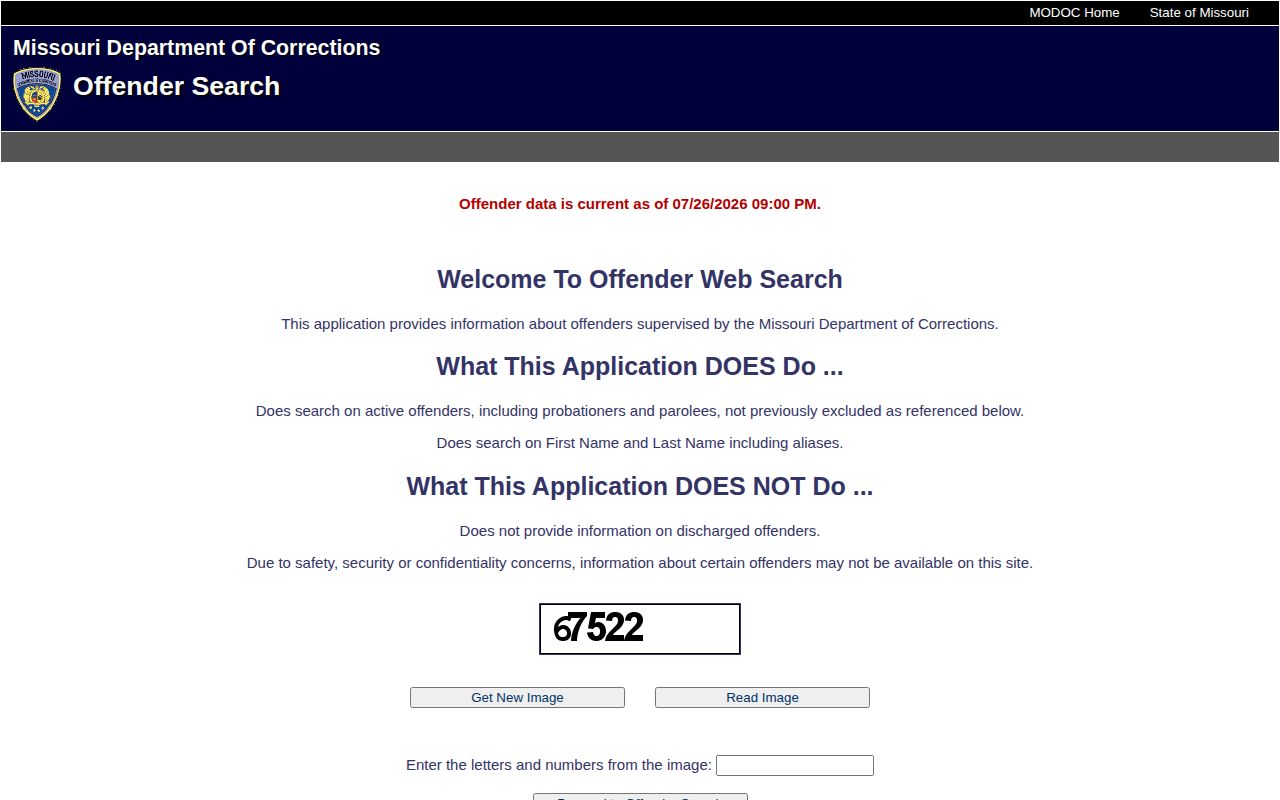
That limit is why an older New Madrid County sentence may require historical DOC data and a direct records request.
Missouri Release Dates Are Different
Missouri’s records distinguish four date concepts that often get merged. DOC’s data dictionary calls the $PC field the Sentence-I Minimum Release Date and the $PD field the Sentence Maximum Release Date. The DOC glossary connects the minimum release date with conditional release in the relevant setting. Separately, the Missouri Parole Board can establish a presumptive parole or release date.
A Board date remains subject to pre-release review. It can be approved, adjusted, canceled, or rescheduled, and conditions may be added. A maximum date reflects the sentence endpoint rather than a promise that confinement lasts until that date. A minimum date is calculated from sentence information, but consecutive terms, an extension, or another hold can affect the full custody picture.
The Missouri DOC glossary capture provides the official definitions behind these distinctions.
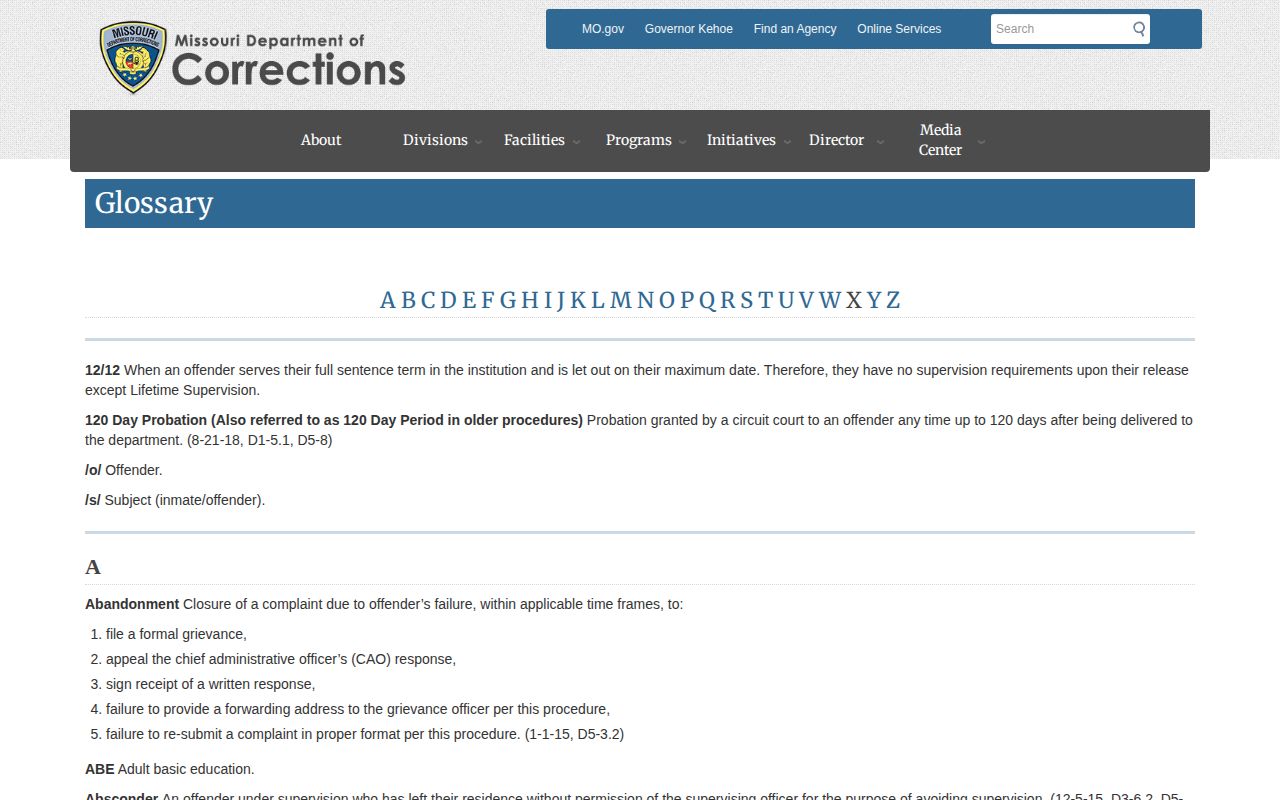
The definitions should be paired with the judgment and current case calculation, not used as a one-field promise of exit.
New Madrid Conditional Release Terms
Section 558.011 divides an eligible term-of-years felony sentence into prison and conditional-release portions, subject to statutory exceptions. For a term of nine years or less, the conditional portion is one-third. For more than nine through fifteen years, it is three years. For a term longer than fifteen years, it is five years. The prison portion is the remainder.
An otherwise eligible nine-year term illustrates the arithmetic: the conditional portion is three years and the prison portion is six years. That example is not a calendar release promise. A dangerous-felony rule, repeated DOC remand, concurrent or consecutive terms, jail credit, later judgment, extension, hold, or other legal provision can change the practical result. The institutional caseworker and sentence record must apply the actual judgment.
- Conditional release
- The statutory community-supervision portion of an eligible prison term.
- Presumptive date
- A future release date set by the Parole Board and still subject to pre-release review.
- Minimum prison term
- A required custody floor that must be met before specified early-release eligibility.
- Maximum date
- The sentence expiration endpoint, not the same as the earliest possible release.
New Madrid 85 Percent Rule
Section 558.019 does not impose a universal 85 percent rule on every Missouri sentence. The 85 percent provision applies to a dangerous felony as defined by state law when the person is committed to DOC. It sets an eligibility floor for parole, conditional release, or another early DOC release. Meeting the floor does not compel the Board or DOC to release the person.
The statute also contains an age-70 alternative after at least 40 percent in the described setting and separate 40, 50, and 80 percent minimums for certain listed non-dangerous cases involving prior DOC commitments. Sentence classification and criminal history must come from the judgment and official record. A simple percentage based on a charge label can be wrong.
Parole authority under section 217.690 remains discretionary. Parole is not a pardon or sentence reduction, and nothing in that section requires a grant. Special offense laws, consecutive minimum terms, and other exclusions may also control eligibility.
Good Time and New Madrid Release
Missouri’s official sources do not support a claim that every state prisoner earns a standard number of good-time days. The supported mechanisms are statutory conditional release, minimum prison terms, discretionary parole guidelines, possible conditional-release extensions for institutional violations, and limited program effects. A New Madrid County sentence should not be calculated with a formula borrowed from another state or county jail.
Earned compliance credits under section 217.703 apply after release to eligible probation, parole, or conditional-release supervision. The statute generally awards 30 days for each full compliant calendar month in an eligible case. Those credits shorten community supervision. They do not generally reduce the prison portion or move a state-prison exit date forward.
For a local New Madrid County Jail sentence, no published county good-time formula or weekend-release policy was found. Ask the jail and court how the judgment and jail credit apply. Do not assume the directory’s weekday administrative hours restrict when the jail can process a lawful release.
Why New Madrid Release Dates Change
A date can move because a sentence calculation is not isolated from later legal and custody events. The source of the change matters. A court modifies judgments, DOC applies institutional and sentence rules, the Parole Board controls its decisions, and another agency can lodge a hold.
| Factor | Possible effect | Source to check |
|---|---|---|
| Concurrent or consecutive sentences | Changes whether terms overlap or follow one another | Judgment, Case.net, DOC sentence rows |
| Jail credit or sentence modification | Changes the applied term or start calculation | Court order, jail, institutional caseworker |
| Institutional conduct | Can support a conditional-release extension under applicable rules | DOC caseworker and official decision |
| Parole Board action | Can set, adjust, cancel, or reschedule a presumptive date | Missouri Parole Board and DOC record |
| Program or release-plan review | Can delay approval or alter conditions | DOC caseworker and pre-release review |
| Detainer or another jurisdiction’s hold | Can cause transfer instead of community release | Holding and receiving agencies |
| New judgment or pending case | Can add custody obligations or change the total sentence picture | Case.net and the responsible court |
A detainer is a request or hold from another authority. It can make a person leave one facility on the expected date while immediately entering another agency’s custody. The first agency may correctly record “released,” yet the person has not returned to the community. Always request the destination when it is public.
Historical New Madrid Sentence Dates
The active offender search excludes discharged people, while the DOC Sunshine file covers current and historical supervision data reaching back as early as 1974, with legacy conversion limits. The file updates nightly and can contain several charge rows for one person. Use the permanent DOC number to join records and compare the case number, sentencing county, completed flag, sentence dates, and minimum and maximum fields.
New Madrid’s sentence-county code is NEWM, but arrest county, offense county, and sentencing county can differ. A completed flag on one row does not prove every term ended. DOC also warns that converted or self-reported material may be incomplete or stale. The data helps form a precise question; a direct agency response is stronger for a disputed actual date.
The DOC historical data page documents the nightly file and sentence-date fields.
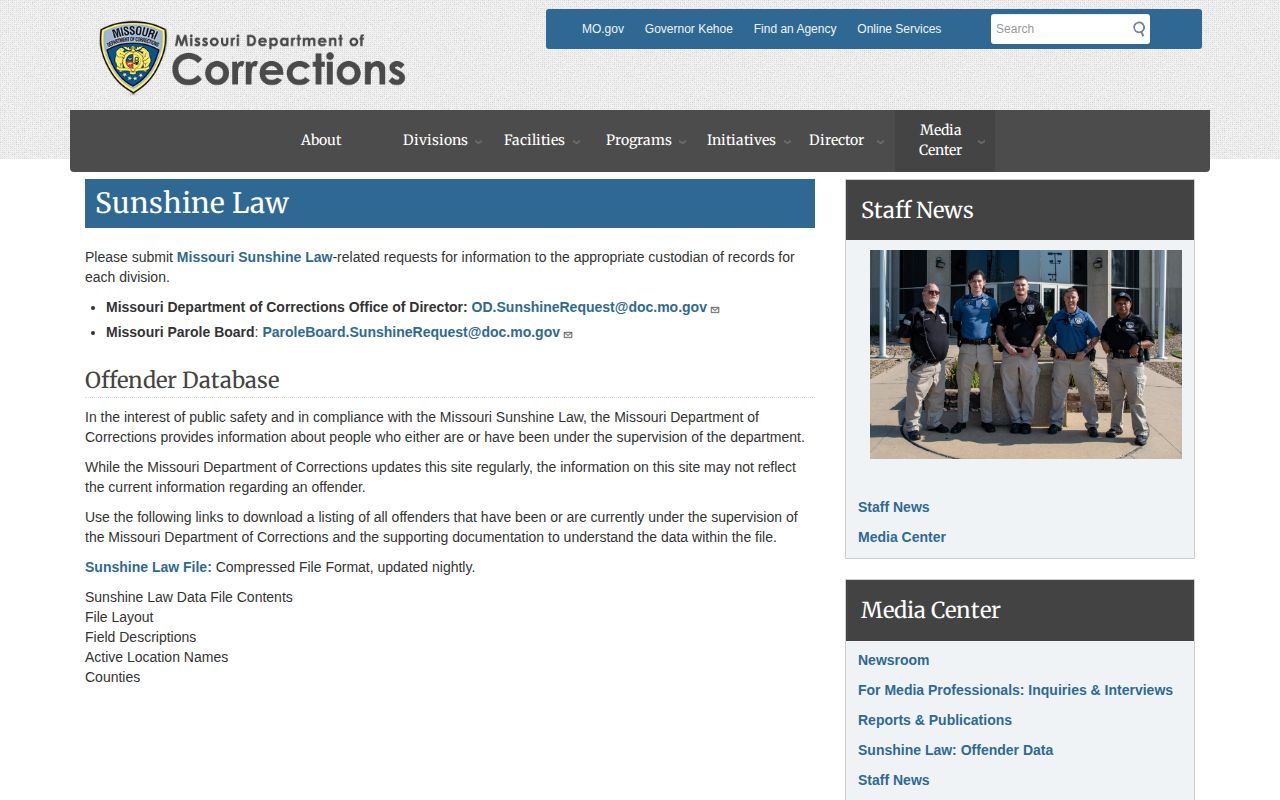
The historical source fills the gap left when a discharged person no longer appears in the active search.
Confirm a New Madrid Release Date
For New Madrid County Jail, request the booking and release record from the Sheriff at 2 Courthouse Square, New Madrid, MO 63869, or call 573-748-2516. Ask for the admission and release date and time, release authority, court-order or bond reference, and transfer destination when public. The listed administrative hours are 8:00 a.m. to 4:30 p.m. weekdays, closed legal holidays. No county-specific online form, fee menu, promised completion time, good-time rule, or weekend policy was verified.
For state custody, ask the institutional caseworker about the live calculation. Send a formal historical request to OD.SunshineRequest@doc.mo.gov for the actual institutional release date, custody-event type, supervision start, and final discharge. Board-specific records go to ParoleBoard.SunshineRequest@doc.mo.gov.
A pending MOVANS notice is useful, but it should trigger a final check. Register through the New Madrid VINELink Release Check, then confirm the completed event with the reporting agency. A projected date answers when release may occur. Only the completed custody record answers when it did.