
New Madrid Parole Versus Probation
Parole, probation, and conditional release are separate legal statuses in Missouri. Parole is a discretionary release granted by the Missouri Parole Board. The prison sentence continues after the person moves into the community. Under section 217.690, a parolee remains in Missouri Department of Corrections legal custody. Probation is a community sentence ordered by a court. It may follow a jail stay, but it can also begin without any state-prison confinement.
Conditional release is the statutory community portion of an eligible prison sentence. Like parole, it can involve DOC field supervision after physical custody ends. None of these terms is the same as final discharge. Discharge means the applicable sentence or supervision has ended. A released New Madrid County person may therefore live outside a jail or prison while still having an active DOC record and reporting duties.
| Status | Who authorizes it | What the record means |
|---|---|---|
| Probation | Sentencing court | A community sentence that may occur without a prison release. |
| Parole | Missouri Parole Board | Discretionary prison release while the sentence and DOC legal custody continue. |
| Conditional release | Missouri law and DOC administration | The community-supervision portion of an eligible prison term. |
| Final discharge | DOC or the court, as applicable | Active supervision has ended; the person may disappear from the active DOC search. |
- Field assignment
- A DOC placement with a probation and parole office rather than a prison institution.
- Absconder
- A person alleged to have stopped reporting or otherwise lost contact while supervision remains active.
- Discharge
- The end of the applicable sentence or supervision, not merely release from a building.
- Detainer
- A request or hold from another authority that can affect where a person goes next.
Check New Madrid Post-Release Supervision
The official starting point is the Missouri DOC Offender Search. It covers people who are incarcerated or actively supervised on probation or parole. Its notice also states that discharged offenders are excluded. That limit matters: no result does not establish that a person never had parole or probation, and it does not identify the date supervision ended.
- Enter the person’s exact first and last name. Try a documented alias only if the exact name does not return the correct record.
- Match the DOC number, identity details, offense, sentence, and case information. Similar names can belong to different people.
- Read the assignment. An institution assignment indicates DOC confinement, while a field assignment supports active community supervision.
- Use the actual field assignment and the current DOC office listing to identify the responsible office.
- Ask the assigned officer or office whether the status is probation, parole, conditional release, interstate compact supervision, or another field status.
- If the person is absent, consult the DOC Sunshine data and request path for supervision start, completion, and final discharge information.
The active search does not by itself prove a New Madrid County Jail release. Someone who posted bond may have no DOC record. A DOC record becomes relevant when a court placed the person on probation, committed the person to state custody, or DOC now supervises the person in the community. The New Madrid County released-inmate search paths help distinguish the county jail record from the state supervision record.
The official DOC search form and its discharged-offender warning are shown below.
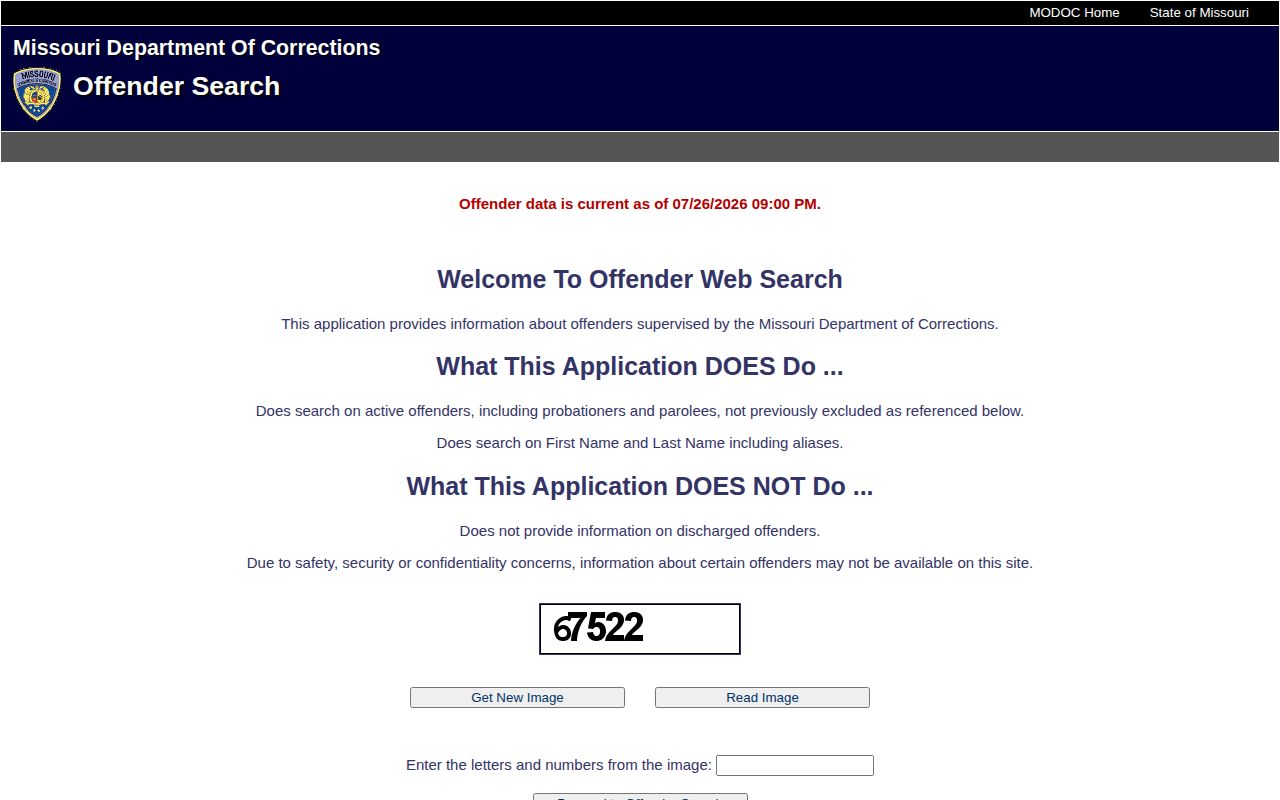
The warning explains why a historical Sunshine record or direct DOC response is needed after final discharge.
District 23 New Madrid Assignments
Missouri DOC District 23 serves New Madrid, Dunklin, Pemiscot, Scott, and Mississippi counties. DOC describes a five-county regional operation averaging about 23 officers, about 54 clients per officer, and about 2,482 client cases per year. Those figures describe regional workload. They are not a New Madrid County count and should not be read as a number of released inmates.
Geography alone does not select the correct office. Current listings include Kennett, Sikeston, and Caruthersville locations, but the active record’s field assignment controls the next contact. A person may also be supervised under an interstate compact or a placement that does not match a home address. Confirm the assigned site before traveling or sending records.
Assignment rule: Use the person’s current DOC field assignment, not an office inferred only from a New Madrid County address.
Kennett Community Supervision Center, 1401 Laura Drive, Kennett, MO 63857, 573-888-4900
Sikeston, 102 Arthur Street, Sikeston, MO 63801, 573-472-5353
Caruthersville, 911 Highway 84, Caruthersville, MO 63830, 573-333-2809
The DOC address listing is the source to check for current office details before contact.
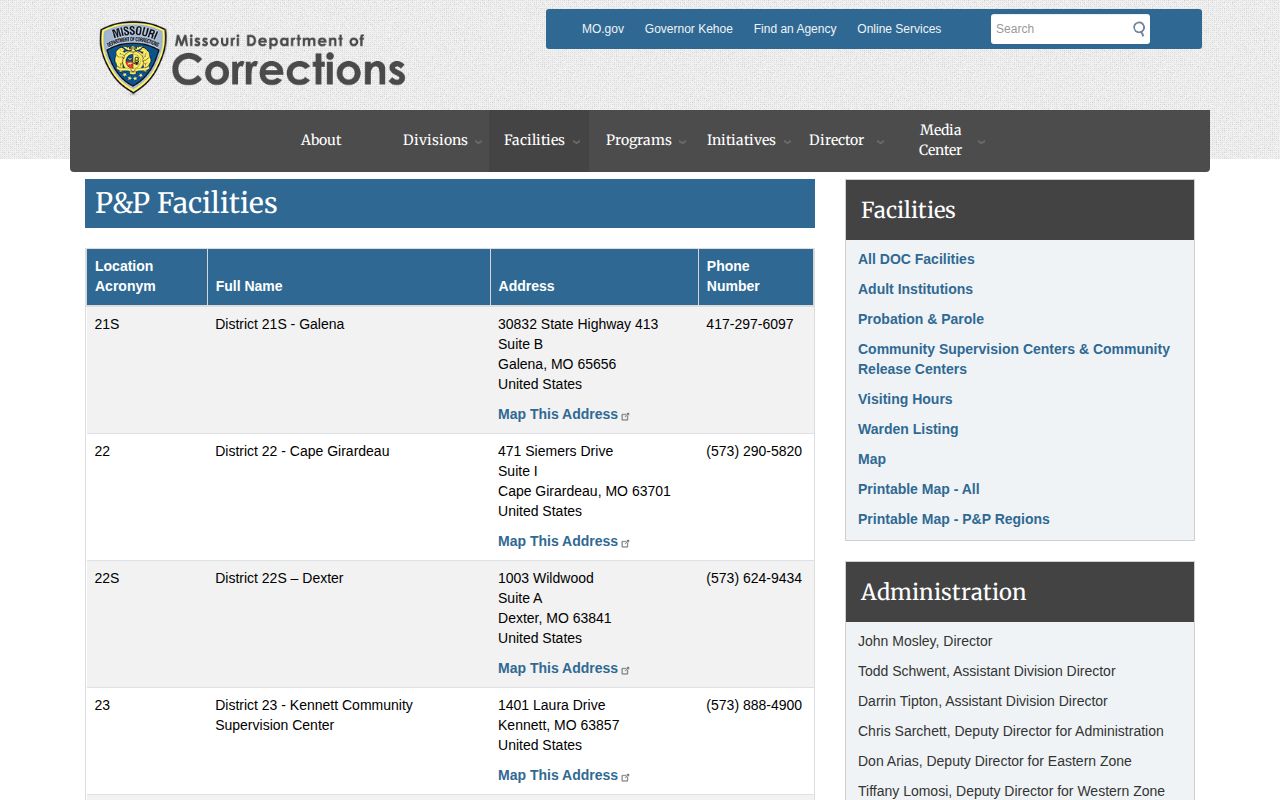
The listing supplies office locations; the individual record still determines which office can verify supervision.
New Madrid Supervision Violations
Supervision conditions are person-specific. They can require reporting, approved residence, treatment, payment, travel permission, or compliance with court and Board directions. The public active record does not provide a complete condition sheet. Questions about a condition belong with the assigned field office, the sentencing court for probation terms, or the Parole Board for a Board order.
An absconder label is not a release type. It generally means supervision remains active while the person is alleged to have stopped reporting, stayed out of contact, or failed a condition. New Madrid County does not have a verified public county absconder list in the researched sources. Confirm a claimed status with the DOC field office and check Case.net for a related warrant or court event. A violation allegation is not the same as a final court or Board ruling.
Section 217.703 also links absconder-related violation reporting to earned compliance credits. A qualifying full month of compliance can earn credit toward eligible community supervision, but a specified violation process can stop credit for that month. These credits shorten eligible supervision after release. They do not reduce the prison portion of the sentence.
Note: A MOVANS alert may report a custody or court change, but the assigned agency should confirm the exact supervision event.
Bootheel Reentry Leads After Release
Historical state materials give New Madrid County a distinct reentry trail. A DOC community activity report identifies grant-supported work through the New Madrid County Family Resource Center, including identification, transportation, family support, treatment or licensing help, and other basic needs. A state health directory also lists a Tri-County Re-Entry Project serving New Madrid, Mississippi, and Scott counties.
These are navigation leads, not promised services. The materials are dated, and current funding, eligibility, hours, and available help must be confirmed by telephone. The directory lists the Family Resource Center at 420 Virginia Avenue in New Madrid and 573-748-2778. A person under supervision should also tell the assigned officer about a transport, residence, or document problem because those facts can affect reporting and a release plan.
The regional setting matters. District 23 serves all five Bootheel counties, while older reentry programs used different county groupings. A New Madrid County address therefore does not prove that one named program or office currently handles a given person. Verify both the service and the supervising assignment.
Replacing ID After New Madrid Release
The historical DOC community activity report specifically identifies help obtaining identification in New Madrid County Family Resource Center reentry work. That can be important after release when a lost ID blocks routine tasks or when a name variation causes the DOC search to return the wrong record. Current aid is not guaranteed, so call the listed resource before relying on it.
A record mismatch should be handled at its source. Compare the booked name, DOC number, date of birth or other allowed identifier, case number, and field assignment. Ask the Sheriff to correct a county booking or release record, DOC to review a state supervision record, and the court clerk to address a docket issue. Do not assume an alias or spelling difference proves that two records belong to the same person.
Confirm New Madrid Supervision Discharge
Final discharge is the point at which the applicable supervision ends. It must not be confused with leaving prison on parole or conditional release. Once discharge occurs, the person may stop appearing in the active DOC search because that tool excludes discharged offenders. Absence is a clue, not a certified completion record.
Use the DOC Sunshine file to frame a focused request. Relevant fields include the permanent DOC number, field or institution flag, assigned place, sentence-completed flag, probation date and term, Sentence-I Minimum Release Date, and Sentence Maximum Release Date. One person can have several charge rows, so a completed row does not prove that all sentences or cases ended.
Send a formal request to OD.SunshineRequest@doc.mo.gov. Ask for the date active supervision began, supervision type, assigned office, earned-credit completion if applicable, sentence completion, and final discharge date. Board-specific records may be requested at ParoleBoard.SunshineRequest@doc.mo.gov. Under section 217.075, DOC records generally fall under Missouri’s public-record framework, while medical, otherwise closed, and security-sensitive material can remain protected.
A parole hearing or favorable decision also does not prove actual exit. Board rules allow later pre-release review, adjustment, cancellation, added conditions, or rescheduling. Confirm the eventual custody event with DOC and, when the person left New Madrid County Jail before state commitment, with the Sheriff’s release or transfer record.